
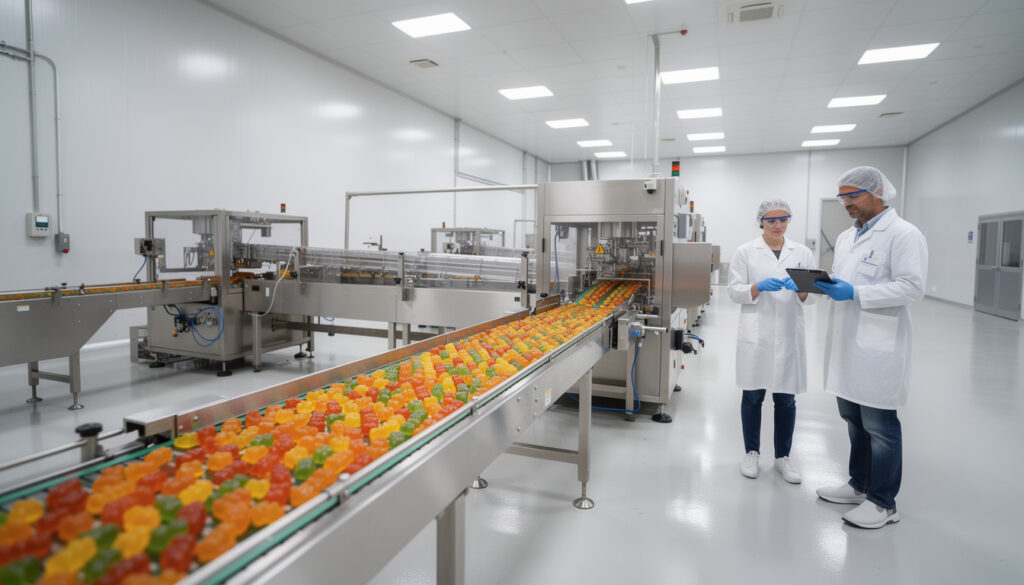


Choosing the Right Gummy Supplement Manufacturing Partner means balancing certified technical capabilities, strict quality assurance protocols, and scalable commercial terms so that a product stays viable once it reaches the market. A poor choice tends to surface late, as failed stability results, stalled batches, or invoices that bear little resemblance to the quote. This guide covers technical audits, quality documentation, stability parameters, cost structures, and packaging qualification.
What Separates a Capable Contract Manufacturer From a Merely Available One?
A gummy supplement manufacturing partner is judged first on transparency: willingness to open the facility, share audit histories, and explain how the gummy matrix behaves under heat, acid, and mineral loads. A Contract manufacturer with modern depositing equipment but thin pectin or gelatin chemistry expertise often struggles with private label gummy vitamins that go beyond a basic vitamin C formula. Capacity matters too, because a line that runs comfortably at pilot volumes may bottleneck at commercial ones.
| Line type | Output velocity | Shape precision | Cross-contamination risk |
|---|---|---|---|
| Starch mogul | High, continuous | Good, depends on mold impression quality | Reused starch can carry allergens or residues between runs |
| Starchless silicone molding | Moderate | High, with sharp and consistent edges | Lower carryover, but mold cleaning needs validation |
| Automated extrusion | Fast for simple forms | Limited to simple shapes | Low residue, fewer design options |
Temperature-sensitive actives such as probiotics and certain vitamins are normally added after cooking, once the slurry cools toward depositing temperature. A capable partner can state the exact point where each active enters the batch and how long it stays hot before depositing.
Red Flags During Initial Vetting
Evasive answers about formula ownership, refusal to share audit histories, and vague lead-time estimates are the standard warning signs. A reliable vendor assigns a dedicated technical account manager and writes support response times and dispute resolution steps into a service-level agreement (SLA).
Paperwork First: Verifying cGMP Compliance Before Any Contract
Before contracting, brands typically request a summary of the Quality management system (QMS), facility certification records, and standardized master manufacturing procedures. Claims of cGMP compliance carry weight only when these documents and recent audit outcomes back them up. A Certificate of Analysis (COA) for each raw material is then read against the Specification sheet, confirming identity, purity, and safety limits.
Supplier qualification shows how the vendor vets its own ingredient sources. Raw material qualification should cover heavy metals testing, pesticide residues, and adulteration screening. Setting empirical analytical specifications for identity, strength, purity, and stability follows the logic of the NIH product integrity guidance.
Release Testing Panels for Finished Gummies
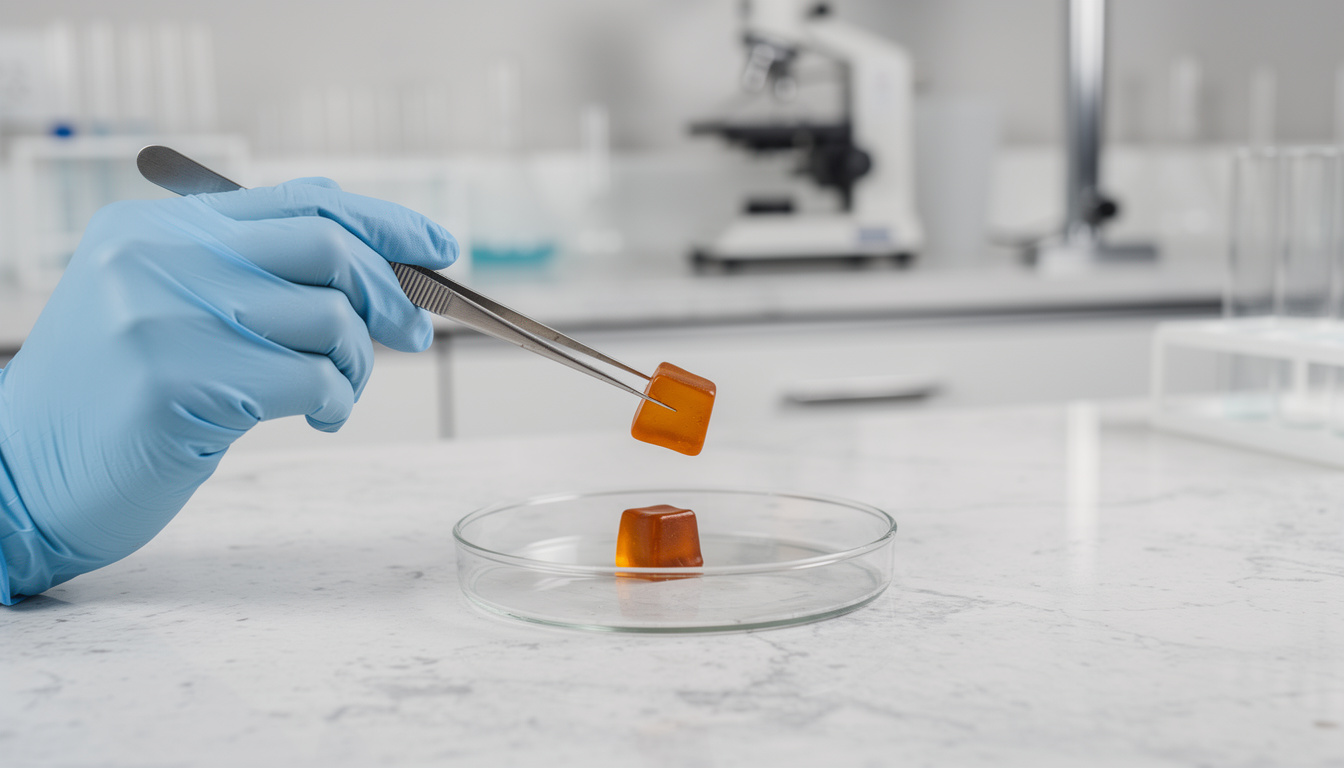
Finished product testing usually combines HPLC for active content, ICP-MS for heavy metals testing, and standard plating for microbes. Microbial limits testing covers total aerobic microbial count (TAMC) and yeast and mold, with pathogen screening for Salmonella and E. coli. Each result is compared against the product's own specification sheet rather than a generic pass mark.
Why Gummies Fail Where Tablets Hold Up
Tablets and capsules are dry systems. A gummy is a cooked, deposited, and cured wet gel, so heat, moisture, and matrix all act on the actives. Water activity (aw) is the main control: holding it at roughly 0.60 to 0.65 limits microbial growth without letting pieces dry out and harden. Poor humectant ratios or temperature swings produce sweating, weeping (syneresis), and sugar blooming.
Heat during boiling and depositing degrades some actives, so a calculated potency overage is built into the formula to keep label claims intact through expiry. High mineral loads and bitter botanicals interfere with gelling and mouthfeel, which often calls for microencapsulation or masking agents. Organoleptic testing panels track flavor, chewiness, elasticity, and aroma. Stability testing runs in real-time and accelerated chambers, with heat and humidity checkpoints at 6, 12, and 24 months.
From Bench Sample to Commercial Release
The usual path starts with R&D flavor and active matching, moves to benchtop sampling and pilot runs that test mold release and curing dynamics, and ends in full commercial manufacturing. Process validation shows that temperature, brix, pH, deposition speed, and curing room humidity reliably produce uniform dosage units. The WHO production guidelines outline the thinking behind validation and controlled batch processing.
During production, in-line checks track weight variation, piece thickness, and the pH of the pectin or gelatin slurry, with organoleptic checks at the depositor. Batch record review closes the loop: quality assurance reconciles ingredient inputs, line clearance documentation, and yield variance before granting release for distribution.
Quote Comparison Mistakes That Inflate Unit Costs
Unit pricing rests on active raw material costs, the base matrix (pectin versus bovine or porcine gelatin), natural flavors, colors, and functional sweeteners. MOQ (minimum order quantity) shifts with line architecture. Continuous starch mogul lines favor large runs, smaller automated batch depositors accept lower volumes, and raw ingredient procurement minimums can raise the figure on either.
The most common mistake is comparing a bundled quote with an unbundled one, since analytical testing panels, mold tooling, pilot run charges, and stability storage fees may sit outside the headline price. A second mistake is skipping the intellectual property clause. Proprietary manufacturer formulations, modified stock bases, and custom formulas owned by the brand carry very different rights if production later moves elsewhere.
Packaging, Allergens, and Traceability After the Line Stops
Packaging compatibility matters because gummy matrices are hygroscopic. PET bottles are light and clear but offer a moderate moisture barrier, high-barrier HDPE performs better, and aluminum-foil-laminated pouches give the tightest protection. Induction seal liners, desiccant pouches, and child-resistant closures help preserve texture in humid storage.
An allergen control program covers facility segregation for dairy, soy, tree nuts, and fish-derived gelatins. Continuous ink-jet lot coding, expiry stamping, and serialization allow a manufacturer to reconcile product quickly after customer returns or market actions.
How long does stability testing take for a new gummy?
Accelerated chambers give early warning signs, while real-time storage confirms the claimed shelf life. Checkpoints at 6, 12, and 24 months are common reference points.
Is pectin or gelatin the better base?
Pectin suits plant-based positioning, while gelatin delivers a more elastic chew but is animal-derived. Cost, allergen status, and the target market usually decide.
Which documents show that a batch is ready for release?
A finished-lot COA, a completed batch record, and a documented quality assurance review that reconciles inputs and yield.
Why do gummies sweat or stick together in storage?
Moisture migration, unbalanced humectants, temperature swings, and weak barrier packaging are the usual causes.
About the Business
Maya Plus is a leading manufacturer of high-quality food supplement and vitamin gummies, offering private label solutions tailored to health-conscious consumers, retailers, and businesses. The company specializes in innovative gummy formulations for men, women, kids, sports nutrition, and beauty applications.


